Friday, December 28, 2012

What Is Wrong With My Foot?


Skin Problems

Bottom of your feet
Problem: It feels like you are walking on pebbles
You may have: plantar warts


Heel or ball of feet
Problem: Thick tough skin on the heel or ball of the foot
You may have: a callus, corn, blister or skin growth


Toes
Problem: Red, peeling, cracking, burning, and itchy skinYou may have: Athlete's foot or shoe dermatitis


Toenail
Problem: Red, swollen and painful skin
You may have: ingrown toenail or an infection


Soles
Problem: red, swollen, painful soles of the footYou may have: bacterial infection

Joint Problems


Toe Joints
Problem: rapid pain, redness, swelling, and heat
You may have: gout or an infection


Problem: swelling or bump at the base of the big toeYou may have: a bunion


Problem: swelling or bump on the outside of the little toeYou may have: a bunnionette


Problem: joint pain, stiffness and swelling
You may have: arthritis, lupus, or gout


Numbness or Tingling

Between Toes
Problem: pain, burning, tingling or numbness in the 3rd and 5th toes, or ball of the foot
You may have: Morton's neuroma

Back & Leg
Problem: pain, numbness, and tingling that begins from the back all the way down the leg to the foot
You may have: pinched nerve


Foot & Ankle
Problem: numbness or pain in the foot or ankle, or a weakened foot
You may have: pinched nerve in the ankle or back


Feet
Problem: burning, numbness or lack of feeling
You may have: poor circulation or PAD

If you have any of the above problems, make an appointment with my office for a diagnosis. The above are generalized & does not constitute an official diagnosis.

Citation:
Image by Praveen Tomy. (2006). Pebbles. Retrieved from http://www.flickr.com/photos/praveenmt/3220243348/

Wednesday, December 26, 2012

When to Examine Children's Feet


As a new parent, have you wondered when you should start examining your child's feet and what you're looking for when you do examine? Here's a general guideline to get you started.

Birth - Newborns should have their foot and legs examined for any potential problems. Podiatrists look for abnormalities such as clubfoot, overlapping toes, web toes, and extra toes. If there is any limitation of motion or problem, it will be addressed immediately.
4-6 mo - Next evaluation should be done at four to six months of age, right around the time that children are beginning to stand. Podiatrists will make sure that the child is developing normally and will have no problems in the upcoming months learning to walk.

1 yr - Around the one year mark, the child begins to walk. Podiatrists will look for conditions like flat feet, bowlegs, knock knees, leg length differences, and any ankle problems.

Annually - Checkups are essential for proper foot care and prevention of problems. As the body changes and grows, so do the feet. This will help identify and allow treatment of most conditions without letting them get too advanced.

Aside from regular checkups, if a child is experiencing any of the following, make an appointment to have their feet look at right away.
  • shoe wear is uneven
  • lumps or bumps are evident on the feet
  • pain in the feet or legs exists
  • tripping and falling occurs
  • skin or toenail problems are present

Citation:
Image by 5 flip-flops Earl. (2012). Kaitlin's foot. Retrieved from http://www.flickr.com/photos/pics2enjoy/807017660/

Tuesday, December 18, 2012

Detecting Foot Problems in Children


Feet and ankle problems often go unnoticed in children. If not caught early, problems can escalate and make treatment difficult. In between checkups, parents can help reduce or eliminate problems by inspecting the child's shoes and feet.

Let's start with the foot inspection:
  1. What is the size of each foot? Don't just measure one foot and assume the other one is the same size. Most people have one foot that is larger. Have feet measured at the store, which unfortunately means you have to bring the child with you to the store. 
  2. Do you notice any blisters, bunions, corns or spots that are just plain red and irritated? 
  3. Do you see any large patches of excessively dry skin? 
  4. Give your child a foot massage and watch for signs of pain or cramping. 
  5. Make note of any problems that necessitate a visit and make an appointment. 

To determine if shoes need to be replaced and not break the bank doing so, inspect current shoes prior to purchasing new ones.
  1. If shoes are snug and too small, purchase new shoes. Shoes that are slightly too big can be worn as long as they will not hinder the child's walk. 
  2. What does the sole of the shoe look like? Was it thin to begin with? Is it thinning due to use? 
  3. Is either heel loose? 
  4. Does the child have adequate toe room? Are there places where the shoe rubs and causes friction against the skin? 
  5. Evaluate the child's walk in the shoes compared to how they walk barefoot. 

Depending upon the answers, some shoes can be repaired instead of replaced. 


Citations:
Basson, Kent. Disabled World towards tomorrow. (2008). Healthy Feet for Children. Retrieved from http://www.disabled-world.com/artman/publish/child-feet.shtml#ixzz22z0oUAd8
Image by Gramody. (2008). Feet! Retrieved from http://www.flickr.com/photos/gramody/2362085621/

Monday, December 10, 2012

Bump On Your Foot?


A bone spur is a bony growth formed on a normal bone. Most people think of something sharp when they think of spur but actually a bone spur is smooth. A spur can cause wear and tear or pain when it presses or rubs on other bones or soft tissues such as ligaments or tendons. Common areas for spurs on the foot are the toes and heel.

A spur is formed by the body trying to repair itself when rubbing, pressure or stress is experienced. Most commonly these occur as part of the aging process. As we age the tissue called cartilage that covers the ends of the bones within joints breaks down and wears away. Over time this leads to swelling and in some cases bone spurs.

Bone spurs can also form in the feet in response to tight ligaments. Activities such as dancing and running as well as pressure from being overweight can put additional stress on your feet. A heel spur can form on the bottom of the foot as the ligament becomes stressed or tight, and it can pull on the heel causing the ligament to become inflamed. As the bone tries to heal a bone spur can form.

Many people have bone spurs without even knowing it, because most cause no symptoms. However, bone spurs in the foot can also cause calluses when tissue builds up to provide added padding over the bone spur. An X-ray can be taken to evaluate whether a spur is causing the issue or not.

Bone spurs don't always need to be treated unless they are causing pain, discomfort or damaging other tissues. Treatment can be directed at the cause, symptoms or the spurs themselves.

Treatment at the cause of bone spurs include:
  • Weight loss
  • Stretching the affected area if it is the heel
  • Ultrasound
  • Deep tissue massage

Treatment directed at the symptoms include:
  • Rest
  • Ice
  • Stretching
  • Ibuprofen
  • Changing footwear
  • Orthotics
  • Padding to the affected area
  • Steroid injection
  • Surgery


Citation:
Photo by Debra Roby. (2007). Toe pre-surgery. Retrieved from http://www.flickr.com/photos/darinhercules/348105594/

Tuesday, December 4, 2012

5 Tips for Running in the Cold


With winter fast approaching, even though it might not seem that way with the 70 degree weather we've been having here in Chicago, runners will soon be turning to their treadmills instead of facing the cold wind and temperatures. Keep in mind that runners can still run in the cold, they just need to take a few precautions to keep warm and safe.  We do live in Chicago where the weather can change multiple times a day. Don't get stuck in the cold. Follow these tips to keep your feet warm during cold weather running.

  • Wear the right socks. I know its tempting to grab your regular old cotton socks, but they don't wick away moisture. Wicking socks are made of fabrics like acrylic or wool.  Use two pairs of socks. Saying Chicago can get pretty cold is an understatement. If it is really cold, wear one lighter sock made of synthetic material and then a thicker wool sock over the thinner sock. Be advised that your running shoes may not fit properly with two pairs of socks. In that case, purchase a second pair of running shoes 1/2 size bigger than you normally wear.  
  • Use hand warmers in your running shoes. Put them inside your sock on top of your toes. Once your feet are warm, they can be taken out as to not overheat.  
  • Avoid puddles, slush, and snow. Use a little common sense!
  • Choose the right shoes. For running in cold weather, choose a shoe with little mesh since that is where water and cold can get through.
  • Wear a hat. What do hats have to do with feet? You can lose up to 40% of your heat from your head. To keep the rest of your body warm, wear a hat.  
Citation:
Image by Jennoit. (2008). Winter run. Retrieved from http://www.flickr.com/photos/benandjenn/2337822453/

Tuesday, November 27, 2012

Take Care With Basic Care


Feet should be frequently inspected for changes, but diabetics need to be diligent in their foot care.

Feet are not that large and don’t change that much, so what do you look for when inspecting feet?

  • puncture wounds
  • bruises
  • pressure areas
  • redness
  • warmth
  • blisters 
  • ulcers
  • scratches and cuts 
  • nail problems

Some areas of the feet may be difficult to inspect by yourself. Ask a family member for help or use a mirror to inspect feet daily.

Here's some basic advice for taking care of your feet:

  • “Always keep your feet warm.
  • Don't get your feet wet in snow or rain.
  • Don't put your feet on radiators or in front of the fireplace.
  • Don't smoke or sit cross-legged. Both decrease blood supply to your feet.
  • Don't soak your feet.
  • Don't use antiseptic solutions, drugstore medications, heating pads or sharp instruments on your feet.
  • Trim your toenails straight across. Avoid cutting the corners. Use a nail file or emery board. If you find an ingrown toenail, contact our office.
  • Use quality lotion to keep the skin of your feet soft and moist, but don't put any lotion between your toes.
  • Wash your feet every day with mild soap and warm water.
  • Wear loose socks to bed.
  • Wear warm socks and shoes in winter.
  • When drying your feet, pat each foot with a towel and be careful between your toes.
  • Buy shoes that are comfortable without a "breaking in" period. Check how your shoe fits in width, length, back, bottom of heel, and sole. Avoid pointed-toe styles and high heels. Try to get shoes made with leather upper material and deep toe boxes. Wear new shoes for only two hours or less at a time. Don't wear the same pair every day. Inspect the inside of each shoe before putting it on. Don't lace your shoes too tightly or loosely.
  • Choose socks and stockings carefully. Wear clean, dry socks every day. Avoid socks with holes or wrinkles. Thin cotton socks are more absorbent for summer wear. Square-toes socks will not squeeze your toes. Avoid stockings with elastic tops.”


Citation:
Vittori Foot & Ankle Specialist. (2012). Diabetes and your feet. Retrieved from http://www.vittorifootclinic.com/library/1800/DiabetesandYourFeet.html

Image by Matthew T. Rader. (2008). My feet. Retrieved from http://www.flickr.com/photos/infinite-magic/497036269/

Tuesday, November 20, 2012

Diabetics Need a Team of Physicians


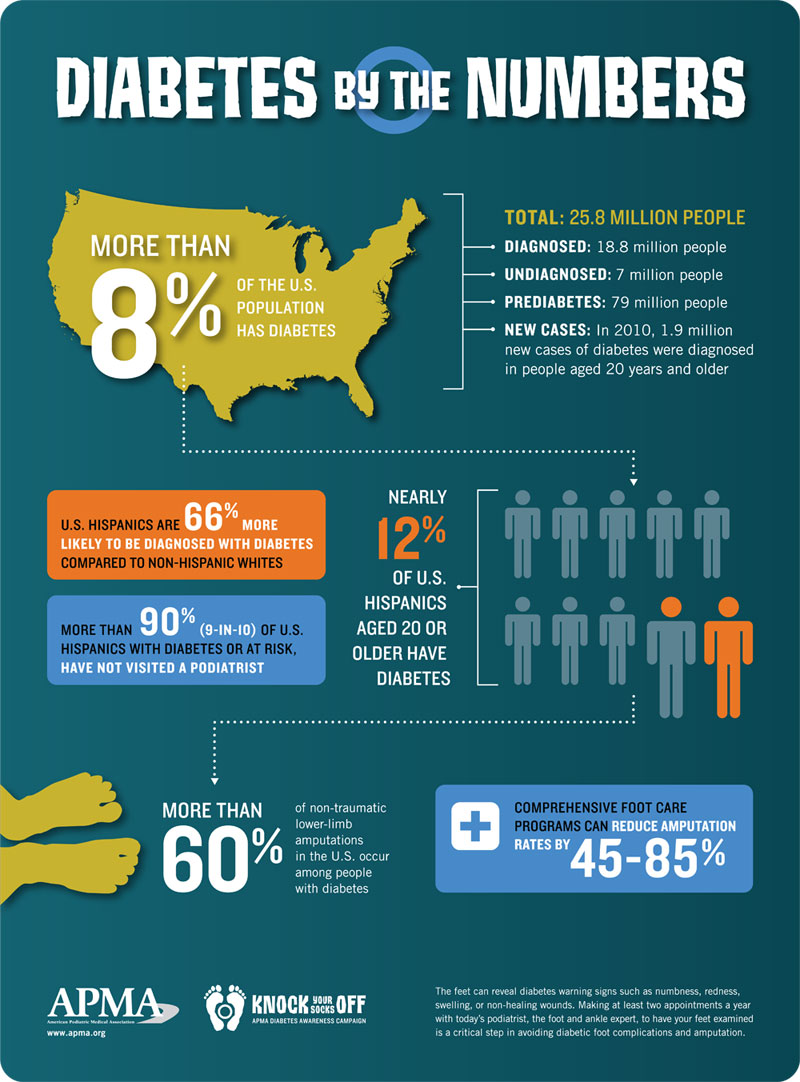
Diabetes affects almost every family these days. The statistics are profound. Take a look at this staggering infographic that the American Podiatric Medical Association has compiled.


Those recently diagnosed with Diabetes should realize they are not alone. A team of doctors will help keep the disease under control and help guide the individual through medical treatments.  Get to know what each doctor or specialist does to keep diabetes in check.

Primary Care Physician – This is one’s family physician, general physician, or internist. They play the role of coordinator by referring to other specialists. When one is seen by a specialist, progress reports are sent to one’s primary care physician. Primary care physicians and specialists work together and keep each other update on the progress of the patient.

Podiatrists – If you’re reading this blog, you know that we treat lower extremity issues of the foot and ankle. It’s imperative to see a podiatrist at least twice a year to reduce amputation rates by 45 – 85%. Diabetes reduces blood flow to the feet and hinders circulation which is why amputation of the lower extremities happens. Many foot complications occur from diabetes; loss of feeling, burning, tingling, nerve problems, circulation problems, and amputation.

Endocrinologist – These physicians deal with hormones and the changes that occur due to the disease. Diabetes affects the endocrine system and endocrinologists focus on how the body is producing insulin.

Dentist – You might be wondering why seeing a dentist is important, but dentists play a key role in diabetes management. Those with diabetes are more susceptible to gum disease and mouth infections resulting from excess blood sugar.

Ophthalmologist/Optometrist – Diabetes affects the eyes, resulting in diabetic eye disease due to restricted blood flow. Just like managing circulation to the feet to prevent amputation, this disease can be prevented if regular check-ups are done.

Vascular Surgeon – They manage vascular diseases, which increase the longer one has diabetes. It’s important to manage blood pressure, stop smoking, eat right, and exercise to minimize vascular diseases.

Pharmacist – Get to know one’s pharmacist. They check to make sure that all prescriptions prescribed by all doctors won’t counter each other or cause unnecessary problems. They also inform diabetes patients about the risks of each prescription. Even if one is taking over the counter medication, consult the pharmacist first to ensure it won’t react badly with other medications.


Citation:
American Podiatric Medical Association. (2012). Footprints. Retrieved from http://www.apma.org/files/FileDownloads/APMA%20Diabetes%20Special%20Edition%20Footprints_2012.PRINT.pdf
American Podiatric Medical Association. (2012). Diabetes by the numbers. Retrieved from  http://www.apma.org/files/images/kyso12_infographic_800.jpg